Doctor of Philosophy. But When Do You Philosophize?
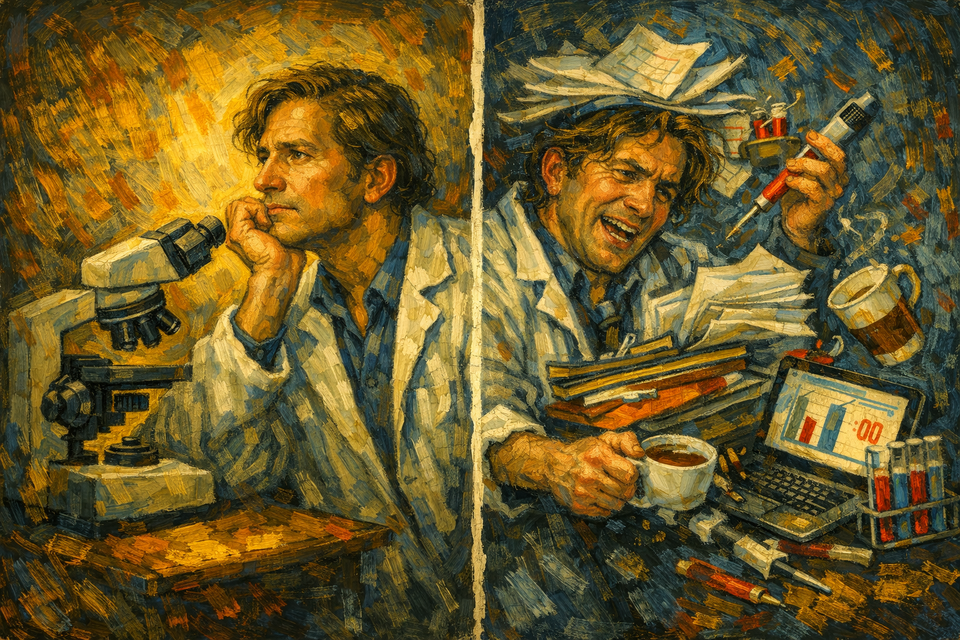
The romantic version of science shows a researcher gazing thoughtfully away from the microscope thinking deeply about life. The real version of science involves dead cells, a screaming timer, and sprinting to start another Western Blot*. In the end, where’s the time to actually think?
In one of the discussions I had with my PhD supervisor when writing my dissertation, I brought up a question about how much I could actually discuss all the possibilities and ramifications of my work. To this he replied “Yes, of course. A PhD is, after all, a doctorate of philosophy”.
And that stuck with me. Because, in the middle of all my PhD shenanigans, the last thing I thought of myself as was a philosopher.
The Historical Ideal
In its core, a PhD is about advancing knowledge, learning how to think independently, and becoming capable of questioning assumptions. Every PhD programme flyer or webpage will say something like this.
And for that, one would expect the time dedication to sit down, think about the science, and allow the brain to grasp the repercussions of a result just observed.
But…
The Daily Reality
In real life, a PhD student’s life has their experiments dictating their schedule, mixed with an obsession for turning data into figures, and an overall need to feel “productive”.
In theory, PhDs are trained thinkers. In practice, they are trained executors.
Now this doesn’t mean that the reflection doesn’t happen, of course. But it happens in the margins, in the remaining spots on the schedule after all the "productivity": between incubations, at lunchtime, while showering, during sleep…
When doing the math, if we compare the time spent reflecting vs. producing, I would bet that there’s an overrepresentation of the latter.
A realistic perspective
After this, you might argue, my dear reader:
But Luís, this is not ancient Greece anymore. What do you expect? People sitting down below a tree waiting for an apple to hit them in the head?
Well, we don’t need to go that far. My point is not “set the scientists free, and let them roam around in an open field so they can touch grass and reflect in peace”.
My expectation is just for more of one thing that I believe is lacking in the entire academic system…
Time.
(Oh, what a dramatic line break this was, right? I love how theatrical one can get even when only writing text).
Yes, time. When looking at academics from afar - seeing them running around, adding more and more papers to their “to read” pile, performing loads of experiments in parallel - the only thing that comes to mind is the clear lack of time.
Time to think. To reflect. To mature ideas. To actually discuss; not in a formal “meeting” or “congress” format, but just… talk. Talk to supervisors. To colleagues. Heck, even talk to complete strangers about science.
The Structural Pressure
And the reasons for this bring us back to the same old culprits: Funding cycles, impact factors, harsh competition, short-term contracts, toxic lab productivity culture, etc…
It’s not that the system doesn’t value thinking. But thinking doesn’t fit neatly into progress reports.
In the current way the system works, reflection feels inefficient. Intellectual wandering seems risky and sometimes it’s even laughed at.
There’s a continuous fear of “wasting time”. When time shouldn’t be seen as something so “wastable” (this is not an excuse to spend too much time scrolling on social media, though).
It seems like the only good PhD student is a busy PhD student.
Career progression = More time to think?
But there’s another nuance here: PIs.
On the trajectory of becoming a group leader, time spent in the lab progressively goes down and the job becomes more and more about the ideas.
This results in one thing: the run to become a PI is also a run for the privilege of finally getting to have a job that is more about the thinking and less about the doing.
One might argue that it’s a natural career progression. A more senior scientist acquired more knowledge, gaining more value as a thinker, while a junior scientist must spend more time “in the field” to learn the ropes.
I will take the liberty to frown upon this concept. Not denying it completely. But questioning it.
Because, to me, that feels a bit like the good old “newbies get to do the dirty work while veterans get to actually experience the fun part”.
Not that the lab work is directly the dirty work (many would argue it’s actually the fun part).
And although it makes sense that a more senior academic is (arguably) better at thinking, limiting the time to think in the learning stages of the academic career is not the smartest move.
It would be like limiting flight time to a learner pilot. Yes, let’s not just hand the junior scientists the whole responsibility of flying this aircraft alone. But maybe let’s give them more time in the cockpit as co-pilots. So that they accumulate more flying thinking hours and become better at acting in possible emergency landings (which in this case would be - I don’t know - a paper rejection or something like that. Yes, I enjoyed this pilot metaphor a little bit too much. Leave me alone.)
Put more Ph in PhD**
The process of doing a PhD should maybe reclaim more time for thinking. A doctorate degree SHOULD be more about the thinking than the technique. Reflection is not anti-productivity, it’s what makes research meaningful.
In the end, maybe the philosophy part of a PhD isn’t in the schedule. Maybe it survives in the pauses that are not reported.
And maybe that could change.
*For those readers outside the field, a Western Blot is a lab technique that consists of running protein extracts on a polymer gel in the morning and ending up sobbing in the late afternoon.
**This was a dangerous word play. There are other common jokes running around about what P H D can mean, and this might sound a bit similar to it.

Comments ()